
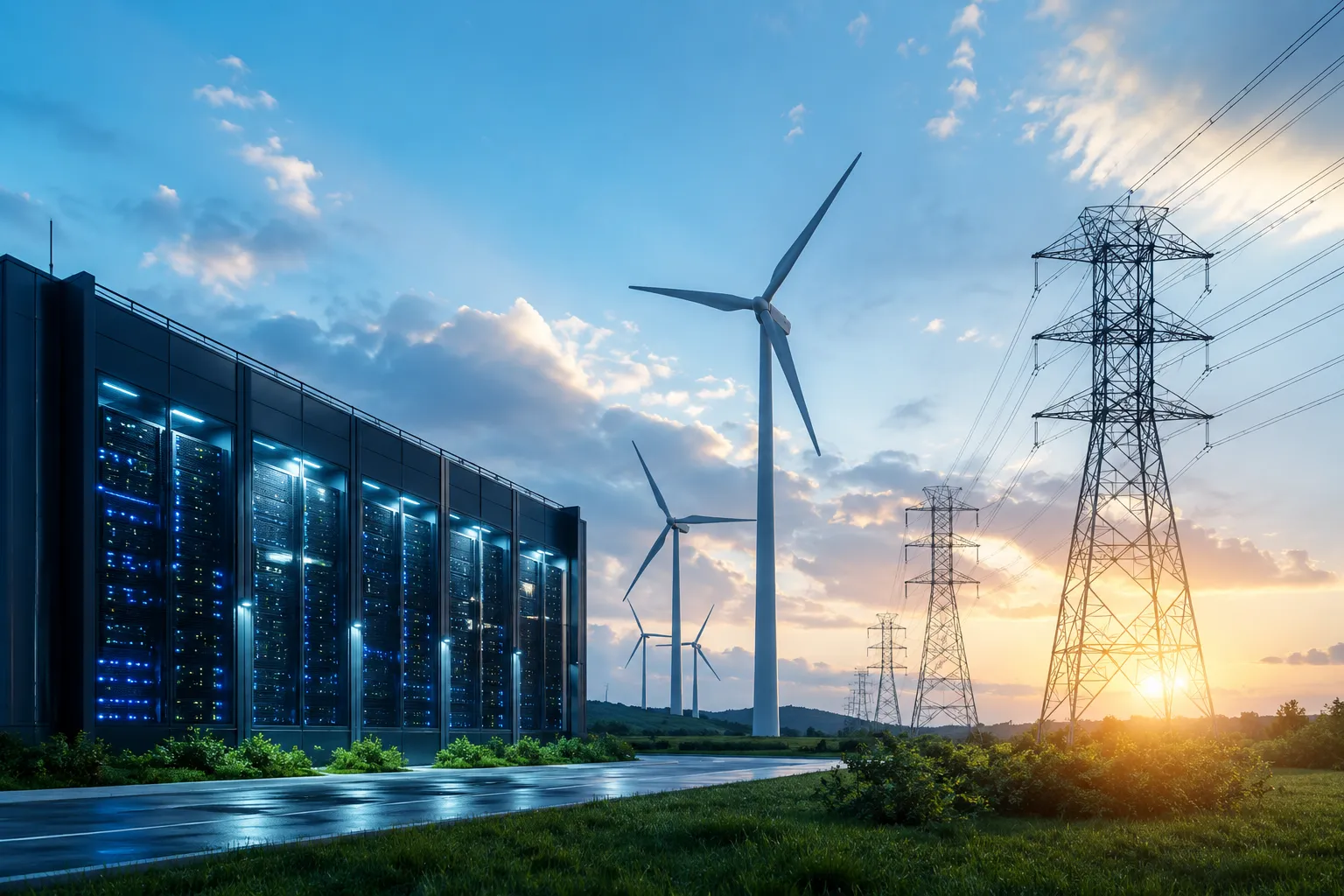
Artificial intelligence workloads have rewritten the rulebook for data center design. Traditional cloud servers run at moderate power draws, but today’s large language models, generative AI pipelines and GPU training clusters push power demands to unprecedented levels. For operators, integrators and facility builders, power is no longer just an afterthought — it is the foundation that determines whether an AI data center can operate reliably, scale efficiently and stay commercially viable.
This article breaks down how power requirements influence every layer of modern AI data center architecture.
1. Skyrocketing Power Density: The Biggest Shift from Legacy Data
CentersConventional enterprise racks often range from 4kW to 8kW per rack. AI racks built for dense GPU clusters regularly hit 30kW, 60kW, and even 100kW+ per rack.
This leap in power density creates cascading challenges:
- Higher concentrated heat output that outpaces standard air cooling
- Heavier cabling, busbar and PDUs to deliver safe, stable current
- Stricter safety standards for electrical distribution inside white space
- Limits on how many high-density racks can be placed in a single aisle
Many older colocation facilities simply cannot support these power densities without major retrofits. That is why new AI builds start with power capacity planning before server hardware is selected.
2. Power Distribution Architecture Must Be Redesigned for AI
In standard data centers, power flows through a familiar chain: utility feed → UPS → PDU → server. AI environments demand more robust, loss-efficient distribution.
Key considerations include:
- Medium-voltage power feeds directly to the facility to reduce transmission losses
- Modular UPS and backup systems sized for sustained GPU loads (not just burst traffic)
- High-current, low-loss busbars alongside heavy-duty rack PDUs
- Real-time power monitoring per rack, per server and even per GPU
- Redundant power paths to avoid hard shutdowns during training runs
AI training jobs may run uninterrupted for days or weeks. A brief power glitch can invalidate hours of compute work, wasting energy and budget. Reliable, monitored power distribution hardware becomes mission-critical.
3. Power and Cooling Are Inseparable
Every watt of electricity consumed by GPUs turns into heat. More power means more heat to remove.
Low-density rooms can rely on perimeter CRAC units and hot-aisle / cold-aisle containment. High-density AI deployments frequently adopt liquid cooling, direct-to-chip cooling or immersion cooling because air alone cannot move heat away fast enough.
Power planning directly dictates cooling choices:
- Facilities sized for 30kW–50kW racks may use rear-door heat exchangers
- 80kW+ racks commonly require liquid cooling loops
- Cooling systems themselves add significant auxiliary power draw, increasing total PUE
Operators target efficient Power Usage Effectiveness (PUE) to keep energy bills under control. Poor power and cooling alignment creates runaway operational costs, even if the IT hardware works perfectly.
4. Uptime, Resilience and Backup Power Strategy
AI workloads differ from web hosting or cloud APIs. Interactive inference can tolerate short interruptions, but long-duration model training is extremely sensitive to unplanned outages.
Modern AI data centers balance several resilience layers:
- Utility grid diversity: dual-feed power where available
- Battery energy storage or rotary UPS for ride-through
- Standby generators sized for full IT + cooling load
- Automatic transfer switches with fast, verified failover logic
- Isolation zoning so a single electrical fault does not take down an entire cluster
Backup systems are not only for grid failures. They also protect against maintenance windows, cable faults and equipment replacement. The power design must match the business SLA of the AI service.
5. Energy Cost and Sustainability Shape Location Choices
Power is usually the single largest recurring expense for an AI data center. That is why developers evaluate locations based heavily on:
- Low, predictable electricity rates
- Access to renewable energy (wind, hydro, solar)
- Grid stability and available utility capacity
- Carbon credits and local regulatory incentives
Many AI operators prioritize green power not only for ESG reporting, but also to hedge against volatile fossil energy pricing. This trend pushes vendors toward more efficient power hardware, smarter load management and demand-response integration with the grid.
6. Practical Implications for Builders, Integrators and Hardware Suppliers
If you design, build or supply materials for data center deployments, the AI power shift changes your product priorities:
- Rack components must support high amperage and better thermal performance
- Power distribution units, cable management and busbar systems need higher ratings
- Cable insulation, routing and grounding standards become more demanding
- Monitoring and sensing tools are required for granular power telemetry
- Installation teams need training for high-density, high-current white-space work
This creates strong demand for specialized auxiliary hardware that supports safe, neat and durable power deployment inside AI racks and aisles.
Conclusion
Power defines the boundaries of what an AI data center can achieve. It sets rack density limits, selects cooling methods, determines uptime strategy, influences site selection and dominates operating expenses.
As AI models grow larger and inference demand expands, power infrastructure will remain the primary bottleneck for scaling. Successful AI facilities are not built around servers first — they are built around a carefully engineered power ecosystem that can deliver stable, efficient and resilient energy to hungry GPU clusters.