
As artificial intelligence, large language models and GPU-accelerated high-performance computing (HPC) continue to scale, traditional air cooling is hitting hard thermal limits. Modern AI servers packed with high-power GPUs generate enormous heat that standard fans and CRAC units can no longer remove reliably or cost-effectively. Liquid-cooled servers have rapidly evolved from an advanced niche option into a foundational infrastructure choice for hyperscalers, colocation providers, research labs and enterprise AI clusters worldwide.
Liquid transfers heat far more efficiently than air. By volume, liquid carries roughly 3,500 times more thermal energy than air, which means cooling loops can pull heat directly from CPUs, GPUs and memory instead of relying on slow, turbulent airflow through racks and server chassis. This fundamental advantage unlocks three core outcomes: much higher rack power density, lower energy consumption and more stable component temperatures under sustained heavy workloads.
Main Types of Liquid-Cooled Server Technology
Two architectures dominate today’s liquid-cooled server deployments, each suited for different project goals and existing data center layouts.
1,Direct-to-Chip (Cold Plate) Liquid Cooling
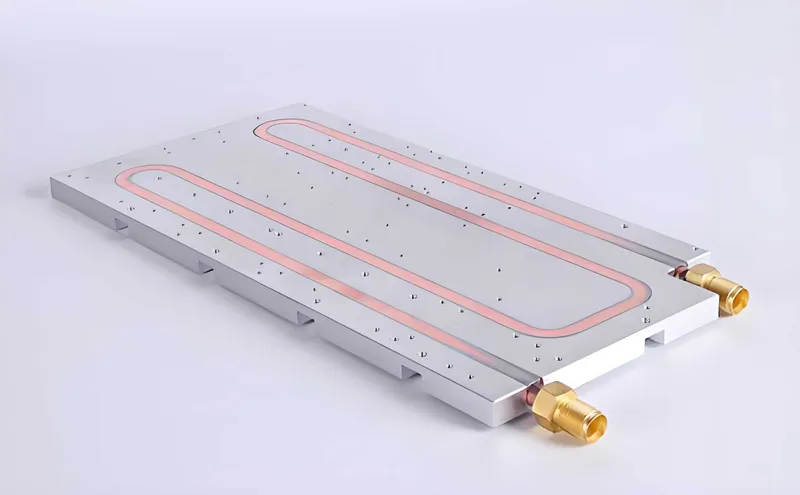
Cold plate cooling is the most widely adopted solution for new and retrofitted AI racks. Thin metal cold plates mount directly onto hot chips, while deionized water or water-glycol coolant circulates through sealed channels inside the plate. Heat transfers quickly from the silicon to the fluid, which flows back to a Coolant Distribution Unit (CDU) before being rejected via dry coolers or cooling towers. Most auxiliary components such as SSDs and power supplies may still use reduced-speed fans.
The biggest advantage is compatibility: cold plate liquid cooling fits inside standard 19-inch racks, works with mainstream server motherboards and minimizes disruption to existing facility layouts. It is ideal for gradual upgrades and mixed air/liquid deployments.
2,Immersion Liquid Cooling
Immersion cooling submerges the entire server node inside a tank filled with non-conductive dielectric fluid. Every electronic component touches the fluid, capturing nearly 100% of the system heat load. Single-phase immersion keeps the fluid liquid; two-phase immersion uses fluid that boils at low temperature for ultra-high heat removal. Immersion supports extreme rack power above 100kW per rack and often eliminates server fans completely. It delivers excellent PUE performance and long hardware life, though it requires purpose-built tanks, modified server chassis and stronger facility planning compared to cold plate solutions.
Rear-door heat exchangers (RDHx) sit between these two approaches. They install on rack rear doors to cool exhaust air with liquid, easing the burden on room-level HVAC. RDHx is often used as a transitional step before full direct-to-chip or immersion rollout.
Key Business & Technical Benefits
1. Higher Rack Density for AI Workloads
Air-cooled racks commonly cap out around 10–25kW. Liquid cooling lets operators run 40kW, 80kW and beyond in the same rack space. This means you can deploy far more GPU compute capacity without expanding white space, a critical advantage when real estate, power feeders or floor loading are constrained.
2. Lower PUE & Energy Savings
Cooling accounts for a huge share of data center electricity. Liquid cooling cuts fan power dramatically and allows higher coolant supply temperatures, enabling more free-air cooling throughout the year. Well-designed liquid-cooled facilities regularly reach a PUE below 1.2, compared to 1.5–1.7 typical for conventional air-cooled data centers. Over multi-year server lifecycles, the electricity savings offset the upfront system investment for most AI operatorsNVIDIA.
3. Improved Server Reliability & Longer Component Lifespan
High fan speed creates vibration, dust buildup and thermal cycling that wear down GPUs, capacitors and connectors. Liquid-cooled servers run at steady, controlled temperatures with fewer or slower fans. Stable thermal conditions reduce unexpected shutdowns during long training jobs and lower hardware failure rates for expensive accelerator cards.
4. Quieter Operation & Better Thermal Predictability
Liquid cooling removes most high-speed fan noise, which is valuable for edge, on-prem enterprise and lab environments. Thermal performance is also more predictable: heat removal is tied to controlled fluid flow and inlet temperature, rather than variable hot spots and recirculation issues common in air-cooled aisles.
Use Cases for Liquid-Cooled Servers
- AI large model training and GPU inference clusters
- High-performance computing: weather simulation, computational fluid dynamics, genomic research
- Crypto and high-throughput compute farms
- Edge and on-prem data centers with limited cooling infrastructure
- Colocation providers offering high-power density racks to AI tenants
What to Consider Before Deployment
Liquid cooling is not “plug-and-play”. Projects require careful planning around CDU placement, leak detection, fluid quality monitoring, pipe routing, maintenance access and safety protocols. Cold plate systems demand regular water treatment to prevent scaling and corrosion. Immersion cooling adds logistics for fluid handling, servicing submerged servers and tank space.
The best starting point is matching the cooling architecture to your power target, refresh cycle and team capability. If you want to boost density gradually while keeping standard racks, direct-to-chip cold plate liquid cooling is usually the first choice. If your roadmap targets 100kW+ racks and maximum energy efficiency, immersion cooling deserves serious evaluation.
The Future of Liquid Cooling
As next-generation GPUs and accelerators push TDP higher every generation, liquid cooling will continue its shift from premium option to default specification for high-power servers. Industry standards, connector designs, blind-mate plumbing and CDU controls are maturing fast, lowering integration risk and driving down total deployment cost.
For data center operators and IT managers, the question is no longer whether liquid cooling matters for AI. It is how fast to adopt it to unlock more compute per rack, hit sustainability targets and avoid thermal bottlenecks that limit your AI roadmap.
Call to Action
Talk to our team to explore compatible liquid cooling server accessories, cold plate components, CDU supporting parts and rack integration materials for your next AI or HPC cluster build. We supply reliable auxiliary hardware built to support stable, long-running liquid-cooled deployments.